How to Study From Recorded Lectures (Research-Backed)

Most students do this wrong. The default plan with a recorded lecture is “listen to it again before the exam.” It feels productive. It’s nearly worthless.
What actually works is shorter, more uncomfortable, and backed by 50+ years of cognitive psychology. Here’s the protocol, the research behind it, and the mistakes to stop making.
On this page:
- Why re-listening fails
- The 4-step protocol
- Things to stop doing
- A realistic week with this protocol
- FAQ
Why re-listening fails
Re-listening (and re-reading) creates an illusion of mastery called fluency. The material feels familiar, so your brain marks it as known. On the exam, when you have to actively retrieve it, the familiarity evaporates.
Roediger & Karpicke’s 2006 study at Washington University split students into two groups: one studied a passage four times, the other studied it once and then took three retrieval tests. A week later, the test group remembered 50% more than the re-readers. Same time, dramatically different outcome.
The mechanism is simple: every retrieval attempt strengthens the memory. Every passive re-encounter does almost nothing.
The 4-step protocol
Step 1 — Get a structured summary (5–10 minutes)
Don’t try to summarize a 90-minute lecture in your head while listening to it again. Use an AI tool that breaks the lecture into:
- Key concepts (the 3–7 ideas the lecturer organized the lesson around)
- Definitions (every term they defined, with their wording)
- Examples (the worked examples — these tend to be the test questions)
- Open questions (anything they flagged as “we’ll come back to”)
Read this, not the transcript. The structure primes your brain with the lesson’s skeleton.
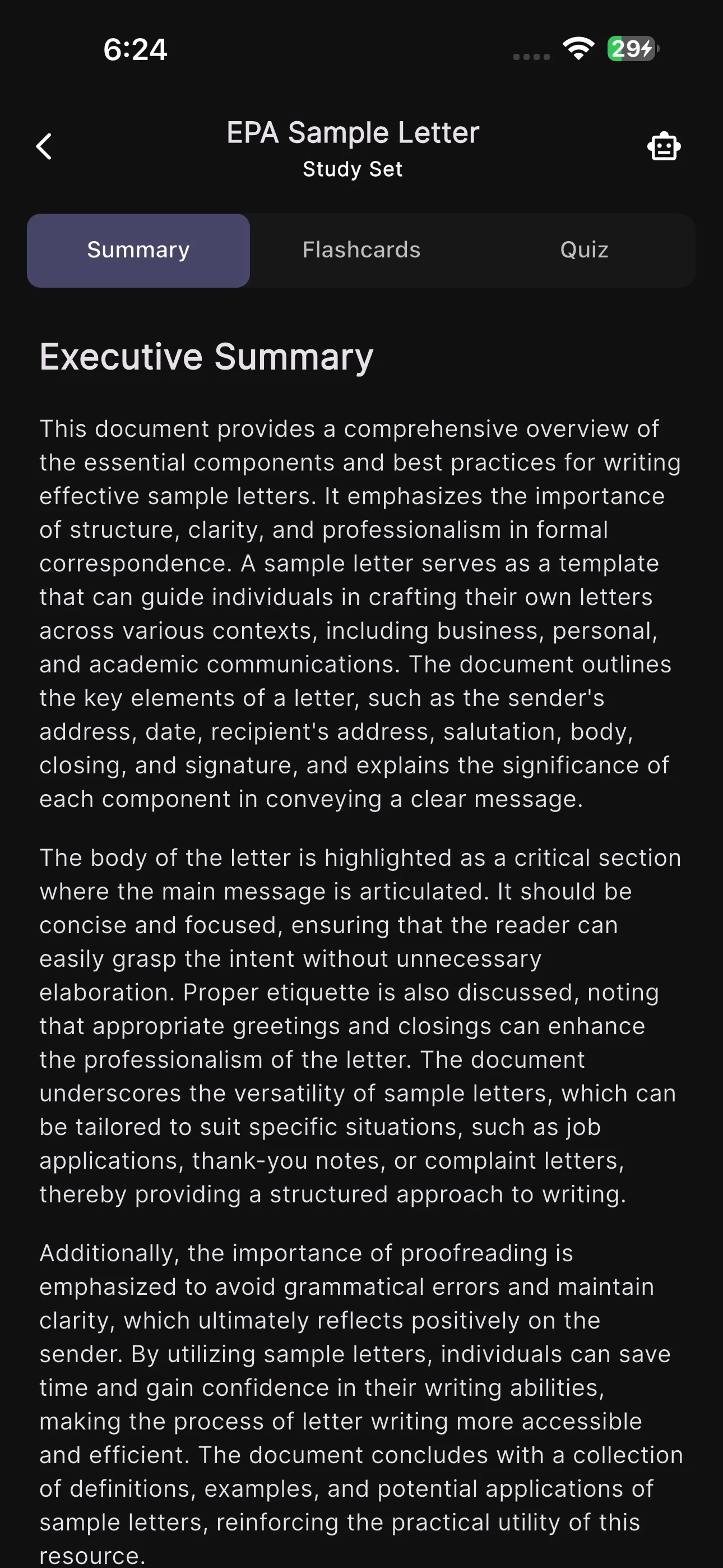
Studr generates this automatically from any audio recording or YouTube link. (See how to summarize a lecture with AI.)
Step 2 — Active recall the same day (15 min)
Same day, while the lecture is still fresh, do one round of flashcards on the material. Don’t grade yourself harshly — even attempting to retrieve the answer is the point.
This is the part that feels uncomfortable. You’ll get a lot wrong. That discomfort is the learning happening.
Step 3 — Spaced review at 2, 7, and 21 days
Run the flashcards (or the auto-generated quiz) at:
- Day 2 — only the cards you missed initially
- Day 7 — full review
- Day 21 — full review
This rhythm comes from Ebbinghaus’s forgetting-curve research and is what spaced-repetition algorithms (Anki, Studr’s built-in scheduler) automate. Each review at the moment you’re about to forget resets the curve at a steeper angle.
Step 4 — Practice questions before the exam
Ideally a week before the exam, take a quiz that tests application of the material, not just recall of facts. Most AI tools generate quizzes from the same source as the flashcards.
If your course has past exams or a question bank — use those instead. Real exam-style questions beat any AI quiz.
Things to stop doing
- Re-watching at 1.5× speed. It feels efficient. It’s still passive listening. The bottleneck isn’t input speed; it’s retrieval practice.
- Highlighting the transcript. Same problem as re-reading. Low-utility per Dunlosky et al., 2013.
- Watching the lecture in the background while doing something else. Divided attention destroys encoding. There’s no version of this that works.
- Saving “study time” for the night before. A 6-hour cram session produces less retention than six 1-hour sessions spaced over two weeks. (Cepeda et al., 2006 meta-analysis.)
A realistic week with this protocol
For one 90-minute lecture:
| Day | Activity | Time |
|---|---|---|
| 0 (lecture day) | Record + auto-summary + flashcards once | 20 min |
| 2 | Re-quiz missed cards | 5 min |
| 7 | Full flashcard review | 10 min |
| 21 | Full review + quiz | 15 min |
Total per lecture: 50 minutes, spread across 3 weeks. Compare to “listen twice the night before the exam” — that’s 180 minutes for a fraction of the retention.
The tooling part
You can do all of this with hand-built Anki decks and a kitchen timer. It works. It also takes 40+ minutes per lecture to set up the deck, which is why most students abandon it.
AI notetakers like Studr collapse the setup to about 60 seconds per lecture. The studying itself — the part that actually matters — is unchanged. You’re still doing active recall. You’re just not spending an hour typing flashcards before you’re allowed to start.
FAQ
What’s the best way to study from a recorded lecture?
Not re-listening. Get a structured summary, do one round of active-recall flashcards the same day, then space your reviews at roughly 2, 7, and 21 days, finishing with practice questions before the exam. Retrieval and spacing — not repetition of listening — are what build memory.
Does re-listening to lectures actually work?
Barely. Re-listening creates a feeling of familiarity (“fluency”) that your brain mistakes for mastery, but it collapses under exam conditions. Studies show retrieval practice beats passive review by around 50% for the same time invested.
How many times should I review a lecture?
Space it: once the same day (active recall), then at about 2, 7, and 21 days. Four spaced retrieval sessions of a few minutes each beat one long cram, and the spacing is what moves material into long-term memory.
Do I need an app, or can I do this manually?
You can do it manually with hand-built flashcards and a schedule — the protocol is tool-agnostic. AI tools just remove the ~40 minutes of setup per lecture by generating the summary, flashcards, and quiz for you.
When should I take the practice quiz?
About a week before the exam, and ideally spaced from your earlier reviews. Testing yourself under a time gap (“the retrieval gap”) is far more effective than quizzing right after studying.
Try the protocol on this week’s lecture
Download Studr for the AI-generated summaries and flashcards. Or skip the tool and hand-build a deck — the protocol works either way.
Adjacent reading: turn any PDF textbook into flashcards covers the same protocol but starting from reading material instead of audio.